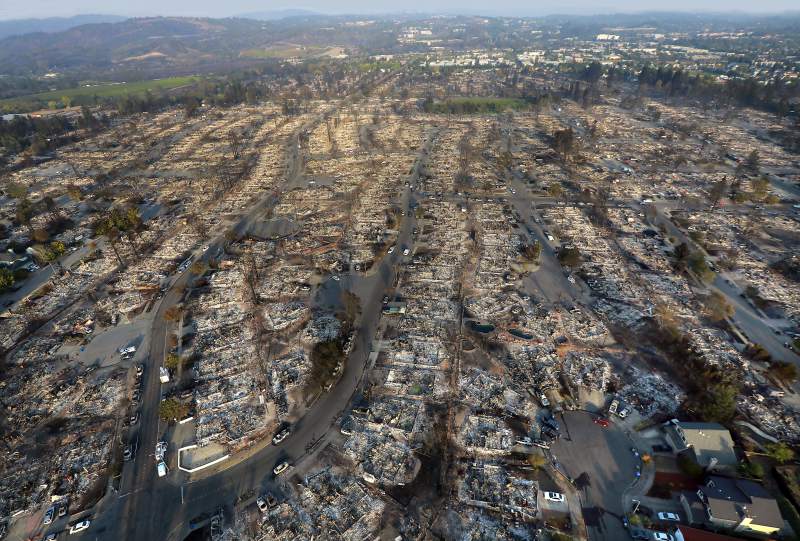
The fires are out, most of the ash and soot is being washed away by the rains, and except for the unluckiest of us, life in Santa Rosa is getting back to normal.
But not for me. For me there were too many important lessons to be learned and the tuition too expensive for me not to pay attention. You see, even though my house survived, the fires have permanently destroyed many of the illusions I had about safety, “property rights” and even about the basic nature of who we are (and can be) as humans
On the Sunday afternoon before the fires I went for a walk with my friend Sheila and we had a fascinating, albeit highly theoretical, discussion about reframing “property rights” as “stewardship rights”. Her view was that the frighteningly fast descent of our species might be slowed down a bit if we could make that conceptual shift when it comes to the earth and all the resources we are in the process of wrecking and rendering useless for future generations. She was totally convincing and with that perspective in mind, I headed off to my men’s book club that evening where we, a group of well-intentioned late middle aged rich white guys, sat around discussing “Evicted”, a heartbreaking book about how impossibly difficult it is becoming for the bottom 10% of America to keep a roof over their heads. To varying degrees we shared our collective and individual shame about having so much, and even more importantly, about how we are contributing to the problem through our current and intended investments in rental real estate.
That night I went to bed with a feeling of deep unease about my contribution to the mess we are in and the even deeper feeling that a few “mea culpa’s” with fellow perpetrators sharing white wine in a comfortable house in San Francisco would not make the situation any better. Nevertheless I slept too well and got up ready to drive up north to take care of some maintenance on our property that is situated just outside of Santa Rosa on the way to Hood Mountain. It is both a second home and an investment, and despite all the talk of the night before, I wasn’t feeling the least bit guilty as I began to pack.
However, as soon as I turned on my computer to check the news, it was clear that I was going nowhere that day. For the next few hours I tried to get as much information as I could on what was going on. We have 8.5 acres and two houses there – a magical place with a year round creek, about 50 fruit trees and an acre of grapes. It’s a sanctuary in the truest sense of the word and to know that it might suddenly cease to exist (or at least be transformed beyond all recognition) hit me hard and in unexpected places. Around noon I got a text from the tenant of the house we rent out who said that he, his partner and their cat had evacuated and were in Sebastapol. This is a tenant with whom I had been fighting with for a while (over noise and boundaries between his space and ours). I hadn’t spoken to him in a month, but when I heard from him, I was truly glad he was safe, and he was glad that I was glad. For a moment, we were not landlord and tenant, but rather just two human beings caught in the chaos of life. It felt painful, but good.
The rest of the afternoon I spent obsessively tracking the progress of the flames and witnessing the horrifying destruction in north Santa Rosa where I used to go for supplies and groceries. Throughout the day I received many texts and e-mails from friends and colleagues who knew about our place and how in peril it was. It was wonderful to know how many people cared, but it was when I got the only phone call of the day that I really learned what I needed to learn. It came from Jorge, a man who until that phone call I would not have called either a friend or a colleague.
Jorge is a day laborer who has done a lot of work for me and my neighbors at the property. I got introduced to him a few years ago by the retired teamster (and Trump voter) who lives across the creek. He introduced him to me as “George, a helluva worker and a helluva good guy”. Since then Jorge has done a number of jobs for me and we have even worked together on some particularly dirty two man jobs where no other workers were available. I’m ashamed to say that in all that time, I’ve learned very little about Jorge’s life. I know he came here from Mexico almost 30 years ago and has worked on properties throughout the area for almost all of that time. I also know that he has a wife and a 7 year old son born here in the US and that in order to be close to his jobs and to make ends meet, Jorge rented a tiny place in North Santa Rosa, while his wife works with her cousins 6 months of the year picking strawberries in Watsonville; 12 hours a day 6 days a week. Through pure random luck (actually to celebrate his son’s birthday), Jorge had driven down on to Watsonville on Friday so the family could celebrate together. It was there that he learned about the fire that had consumed his neighborhood in Santa Rosa and was threatening the houses of many of the property owners that he had worked for over the years.
He called me because he wanted to know if I was ok and had escaped the fire. In fact he had spent the day calling everyone he knew to check on them. From him I learned about the 90 year old couple next door (ok as they were picked up by their son), and others who were not so lucky. The one person he couldn’t reach was our neighbor Mark who, we both speculated, was still at his property ready to fight the fire and defend his property all by himself. It would be almost 2 weeks before I found out the full story of what happened to him and some of my other neighbors during the event, but for the moment I was just completely absorbed in what Jorge was telling me. It almost brought tears to my eyes to listen to this man, who, even though he didn’t know me well and though he had likely lost most of the few possessions he had, was reaching out with open hearted compassion and interest to find out what was happening to me and my family, wanting to pass on any bits of information that he knew that might in some way help me deal with my problems. But beyond his selflessness, the thing that struck me right to the core was how much joy and gratitude he was exuding. He was with his family and they were safe. It was all he needed for himself, and now he was showing me the best of what we can be as human beings. He was a beam of bright light on a very dark day.
Over the next few days the news got worse, then better, and then much worse. Over 20 separate fires had broken out across the North Bay and two of the major ones (the Tubbs and Nuns Fires) began converging on our property, kept away only by the fickle wind and the almost superhuman efforts of the Cal Fire crews. The roads throughout the area were closed and rumors began circulating that looting of evacuated but still standing houses had begun. As my cell phone continuously beeped with emergency updates from the Sonoma County sheriff, I thought that maybe this really is our future; little pockets of hell springing up all around the country eventually converging and combining into one final conflagration, but against all reason, knowing there are people like Jorge and the firemen putting their lives on the line for the rest of us, I couldn’t help but feel some hope.
For over a week the battles raged with ground gained and lost, and unlike wars of the past, it was possible to follow the flames by satellite and internet. Just when it seemed that the worst was over, that Cal Fire was gaining the upper hand on the two main fires threatening our houses, a new fire broke out near the Oakmont retirement community just 2 miles down the road from our place. Things now looked very bad. The fires raced up the hills just to the south of us and Hood Mountain itself was on fire. The flames were now coming down the hillside toward the Creek where one of our houses is situated and on whose banks we have spent countless summer hours enjoying its coolness and winter nights listening to the roaring water just outside our bedroom window.
And then suddenly it was over. Just 500 yards from the properties on the other side of the creek, the fires were stopped. It took another day for Cal Fire to secure the line and two days of rain to douse the hotspots and cleanse the air sufficiently to allow property owners to return to their homes. And so on Saturday October 21, I prepared myself to drive up to Santa Rosa to see first hand what had become of our second home.
AFTERMATH
Almost exactly two weeks after the fires began, I returned to Santa Rosa to see what remained. As soon as I got off the highway and headed east toward our property, I got my first shock. The Sonoma County fairgrounds, a normally empty and expansive network of fields and barns had become a refugee camp, with wandering homeless, tents, medical stations as well as police and military vehicles strewn as far as the eye could see. All along the road back to my property were signs and flowers, mostly thanking the firefighters and other first responders, but also some expressing gratitude or grief – for what was lost and for what still remained.
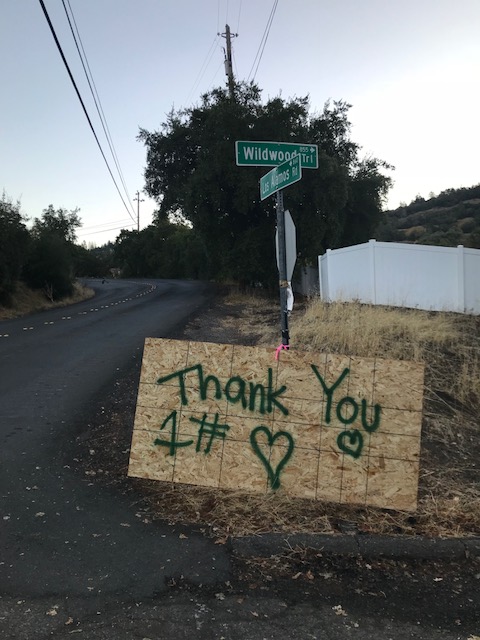
At the corner of our street was this sign, typical of the sentiment welcoming me back home
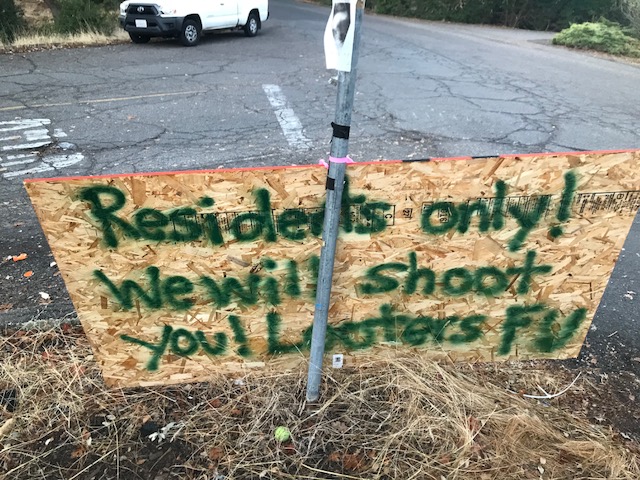
My relief and gratitude were tempered somewhat, however, when I turned onto the road and saw that on the back of the sign was another message that had been left by my neighbors who had evacuated several days earlier.
I drove up the road and saw that while our houses had survived, they were not untouched. In fact Cal Fire had used our property as a back up staging area, prepared to fight the fire from the steps of our house if it had gotten as far as the creek running past the property. Even though the battle had been won, the firemen had clearly left in haste; leaving axes, firehoses and much debris as well as broken fences, gates and doors in their wake. As I surveyed the scene I was filled with an undigestible mix of deep gratitude for the brave men and women who saved our property, dread at how close the fires had come, discouragement at the amount of effort it was going to take to clean up the mess and just a tinge of survivor’s guilt when I compared my problems to the vast scale of the destruction throughout the City that will take years to recover from. It was a truly disorienting moment.
To ground myself, I walked across the creek to visit Mark who I found helping one of his tenants rewire another tenant’s pick-up truck. As I mentioned, Mark is the retired teamster Trump voter who is my closest neighbor. He has a similarly sized property to ours, only his is crowded with a motley collection of structures, vehicles, dogs and tenants inhabiting it. He himself lives with his wife in a small apartment attached to the back of a 2000 square foot Quonset Hut filled to the brim with tools (power and otherwise) used appliances, and semi-serious construction equipment. He is a unique individual in more ways than one and among other things is our resident historian having been married for 55 years to the granddaughter of one of the original residents who settled the area.
The history of Mark’s property as well as that of most of the neighbors up the hill towards Hood Mountain is full of intrigue, quirky characters and real Wild West drama. To this day Mark feels that he was cheated out of his fair share of the 500 acre plot up the hill that his wife’s grandfather owned and in whose house she lived as a child. It’s a story I’ve heard at least a dozen times, but one that seems to change in detail with each retelling. The only constant is that at some point there was a rigged property auction held by a crooked judge after the old man died and in the ensuing court battle Mark and his wife only came away with the 6 acres by the Creek that they still live on.
Knowing Mark, and having it now confirmed that he never evacuated when the fires came, I was anxious to hear his story. I was fully expecting to hear a harrowing tale of what he witnessed punctuated by his justification for refusing to follow the order to evacuate and a rant about how no government authority could tell him to leave the property that he fought so hard to get and keep over so many years.
But instead I was surprised by what he had to tell me, and like Jorge, I realized that Mark was not at all the man I had thought he was.
It seems that Mark knew all too well the risk he was taking but he didn’t hesitate for a moment in deciding to stay. Because in addition to knowing the risk, he also knew that by staying he could make a real difference – not just in saving his own property, but in helping the firefighters save his neighbors’ homes and to help them stay safe as possible while doing so. So he acted; immediately and with purpose. He first made sure that his wife, his tenants and all their pets were safely evacuated, shuttling some himself down to the local Safeway where buses were available to take them out of harm’s way. Then he went back to the property and welcomed Cal Fire equipment and volunteers (some of whom had come in from distant states and were completely unfamiliar with the geography) to his home and proceeded to serve as guide, host and advisor for the next few days.
When I listened to his account of what happened, I was immediately struck that the narrative did not have the usual bluster, humor or “us vs them” quality that I had come to expect from his stories. Rather it was a story of a band of warriors who had fought and defeated a fearsome and lethal enemy, of an army that he felt honored to be a part of. He had a quiet pride about the fact that his extensive knowledge of the terrain as well as the resources he had built on the property – the multiple outlets to his well and water storage tanks, the generator that provided electricity, the food supplies he had stocked for just such an eventuality all had proven invaluable. He was too old now to be on the frontlines, with the chainsaws and the hoses, but he had acted with the same selfless sense of duty and love for the land and its inhabitants, and now he was basking in the glow of having successfully defended the homefront.
So in the end, what are “property rights” and how do you get them? Is it a recorded deed in some County Clerk’s office? Is it something that you buy with money or obtain with power or blood? Or is it something more elemental, and something that you have to earn, defend, and then deserve? I really don’t know the answer anymore.
When I think about the love of the land and his neighbors that both Jorge and Mark showed me in the last month it makes me reexamine my own relationship to that beautiful 8.5 acres that I used to think of as “mine” and the community which it is a part of. My family feels that our place is “too much work”, that the area will never be the same, and what we should do is sell our property to someone else who will be a better “steward” of the land. I am not at all sure they are wrong, but whatever we do, we will do it with heart and a recognition that a place is much more than a spot on a map or a Title and a bank account.