Tag Archives: money mountaineering

Holistic Financial Wellness Principles: Principle #6 – Optimism Bias

For this, my final essay on the principles of Holistic Financial Wellness, I need to disclose some aspects of my life that in normal circumstances I would never consider writing about and posting where strangers can read. I do so, however, because throughout Money Mountaineering and in the previous 5 essays, I have not shied away from sharing aspects of my life that bear directly on the issues I am discussing. To not do this now, would be the height of hypocrisy.

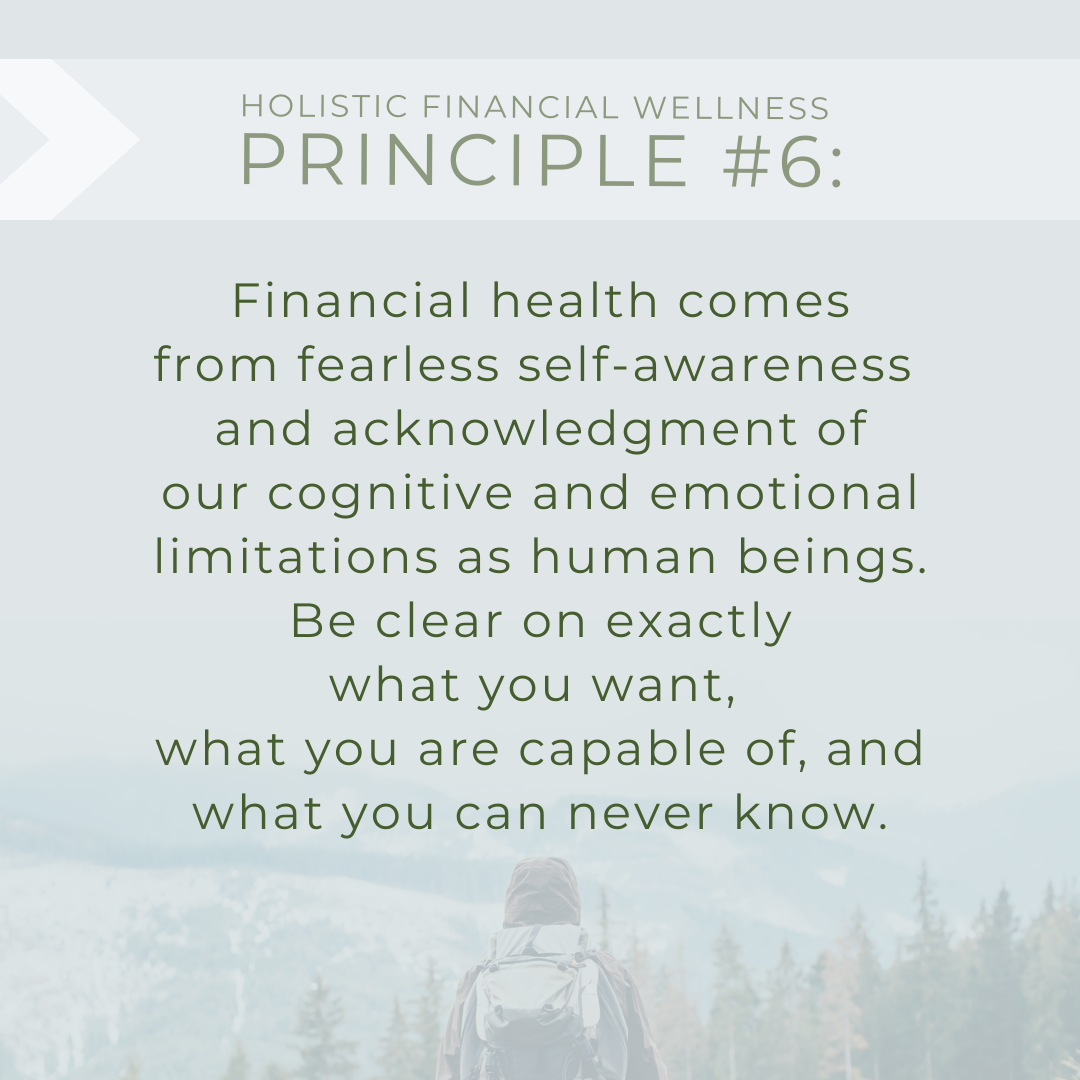
HFW #6 is all about our irrationality and the blind spots we all have when it comes to making important financial decisions. It advises you to strive for “fearless self-awareness” and to take note of our limitations when we consider our own situations and the areas where we may need help. So today I want to walk my talk and share one of my blind spots that has disrupted my financial life, and unfortunately was not explicitly addressed in Money Mountaineering.

In What’s Your Future Worth? and in Money Mountaineering, I have expressed my view that predicting the future is impossible, but imagining it is not. In fact, my recent essay about HFW#4 addresses this directly by noting how important it is not to anticipate what the future will hold, but instead we try to imagine what might happen and then prepare for it. In my most recent essay on HFW #5 I counseled that you follow my father’s advice and “hope for the best but prepare for the worst”.

And while I have generally been able to adhere to the 6 principles I espouse, my financial life was recently upended by one of the most important financial contingencies out there that affects several hundred thousand of us every year and millions overall. In retrospect, I wish I would have included at least a brief discussion of it in Money Mountaineering, but for reasons that will soon be apparent, I didn’t.This essay is my attempt to rectify that omission, while at the same time expanding on the notion of what I mean when I say that financial wellness requires that we “acknowledge our cognitive and emotional limitations as human beings”.

.
.

Optimism Bias and a Failure of Imagination

In Chapter 11 of Money Mountaineering, I describe what I consider to be the most important emotional biases and cognitive errors that we can fall prey to when we make financial decisions. In preparation for writing Money Mountaineering, I reviewed much of the Behavioral Economics literature and discovered that in the years since I had been immersed in the subject, many more “system bugs” in our make up had been discovered and explored. To make the book as useful as possible, I decided to focus on what I considered to be the most important and “dangerous” aspects of our “programming errors” that can prevent you from making good financial decisions.

In the book I describe 8 emotional biases and 7 systematic cognitive errors that we are all prone to, but I left out one emotional bias that not only is important but is also one that I recently fell prey to in my own life. Ironically enough it was probably this bias itself that caused me not to explicitly address it anywhere in the book, and it is one which I want to talk about now. Specifically, I am referring to what is called “Optimism Bias”.

Optimism bias is a bias that “causes someone to believe that they themselves are less likely (vs what the actual probabilities are) to experience a negative event” (see for example https://en.wikipedia.org/wiki/Optimism_bias). While this bias has been observed by psychologists since the 1980s, systematic analysis of this bias only began in the last 20 years (see for example http://www.crossingdialogues.com/Ms-A14-09.pdf).

I doubt that adding one more bias to my Chapter 11 catalogue of our emotional biases and cognitive errors would have made for better reading, but still, I regret not discussing it – especially because the financial consequences of optimism bias can be significant.

Right now, I am suffering the consequences of what can happen if you ignore the full range of unpleasant ways a decision might turn out. Fundamentally, I experienced a failure of imagination and I want to talk now about how it happened.

Time Traveling and Imagining a Painful Future

In the last chapter of my first book What’s Your Future Worth? I describe the first conversation I had with my wife about our respective personal balance sheets. It happened on our very first date as we were getting to know each other, both of us very much realizing that we liked each other very much. We disclosed our financial situations to each other — my significant accumulated assets and her bright red ledger full of student debt accumulated in pursuit of her Ph.D.  I had no doubt in my mind that pursuing her was the right thing to do, and in the book, I describe my thought process (clouded by emotional biases of all sorts as it undoubtedly was).

That initial conversation took place in 1995, and the next time we addressed the subject was shortly before we got married at the end of 1998.

In that second conversation a few months before our wedding date, my bride-to-be asked me whether I was going to ask her to sign a pre-nuptial agreement to deal with the wildly different financial situations we were bringing to the marriage.

This question was, in one sense, not about money, but in another sense, it was only about the money. In fact, it was a very specific question about what would happen to our money during the marriage, and more importantly – what would happen to our money if our marriage did not survive.

It was not as if I hadn’t thought about the question. I had. In fact, I had thought very deeply about it and when my fiancé asked the question, I was not the least bit surprised.

Before I tell you how I answered her, I need to first acknowledge what many of you already know, but perhaps some of you don’t. My wife and I separated at the end of March 2020 shortly after COVID locked us down together in our house in Berkeley. I moved out to live full time at our farm in Santa Rosa, and that is where I live now.

We are currently in the process of working through the excruciating details of a legal divorce that I hope will end soon. As I say, Divorce is a financially significant life contingency that affects many hundreds of thousands of married couples every year. And that is in normal years when there are no wars or pandemics – events that seem to bring some families closer and blow others apart. For example, right after World War II the divorce rate in the US was dramatically higher than it was in 1955, just a few years later when my parents got married (3.7 per 1000 people in 1947 vs 2.3 per 1000 in 1955) My parents recently celebrated their 66th wedding anniversary, but I won’t — even though the annual divorce rate throughout most of my marriage has “only” been between 3.5 and 4 per 1000 each year (https://divorcescience.org/2013/03/12/us-divorce-rate-2001-2011/).

Part of the issue is just pure math. Note that over a 20-year marriage even a 3.5% annual divorce rate means that you will have less than a 50-50 chance of emerging from two decades still together. This was a fact that I was well aware of when I got married, but I did not let that dissuade me. For me, the risk was far, far outweighed by other non-financial considerations, and if you read What’s Your Future Worth? you will understand why.

I think there are two main reasons that I am in my current situation. The first and obvious reason is that I simply fell prey to optimism bias. The fact is, I just didn’t believe it would happen to us. It’s not like I shouldn’t have known better.  As I said, the data told a pretty clear story. But the problem with average data is that we all like to believe we are not average. In fact, we aren’t, but averages do matter, and our emotional biases very often steer us to ignore the odds that we can use to make better decisions.

Actuaries are people too, and I was not immune to the perils I outline in Chapter 11. I was convinced I knew better, and even though I periodically visited actuarial websites where an algorithm would calculate my actual individualized odds (always telling me I was a heavy favorite to get divorced), I simply would find reasons for their being wrong. Finally admitting defeat was not easy. Especially when my optimism bias made it so much harder to realize that my marriage was finally over. 

Had I realized what was happening at the time I might have written about it, but had I done so, I wouldn’t have written it in the way I would now. I understand the nature of the financial risk divorce poses much better now and it is a very complicated one, particularly with respect to the timelines and unexpected financial surprises (mostly bad) that inevitably arise when two human beings decide to end their marriage. We are not rational creatures, and I guess that is why we have lawyers to help us sort things out.

That being said, there was a time when I was thinking pretty rationally, and that was before the marriage. When my fiancé and I sat down to discuss the pre-nup, I had done my work on considering as many scenarios as I could imagine, but almost all of them involved enduring some very painful Time Traveling, and while I did do my due diligence and took steps to prepare for the contingency, it was not an exercise I enjoyed or did particularly well.

The fact of the matter is that not only is every individual’s probability of getting divorced a function of many variables – some known, like age and duration of marriage, but there are many others that are unknown and often random. And not just random, many are random events that come from an unknown distribution which we can never discern.

One thing I did do, and you can do as well – in addressing this as well as all the other life contingencies that you don’t want to think about — is to ask yourself a lot of “what if” questions and then try to inhabit your future self. When you get there, look at the possible financial situation you will find yourself in, and try to imagine how you will feel under each one. It’s painful work, but it can help you make better financial decisions.

These days, when I am often tempted to kick myself for making a bonehead decision, I remember Annie Duke’s counsel against “resulting” – i.e., thinking you made a mistake just because your decision turned out badly. I still feel like I did the right thing, it just didn’t turn out as I had hoped.

For obvious reasons—both legal and ethical, I won’t disclose any more of the details of my divorce. I will, however, tell you the rest of the conversation my wife and I had before we got married – at least I will tell you my memory of my side of the conversation. I do so, because one of the first decisions you might have to make before you get married and before you must decide whether to say “I do” to whoever is empowered to witness your contract, is to decide whether or not to have a pre-nup.

As you may have come to realize – I don’t like to give advice. Instead, I’d rather simply tell you what I did and why I did it.

My fiancé asked me whether I was going to ask her to sign a pre-nup before we got married and I said no. I said I thought that California Divorce law was perfectly reasonable – whatever assets each party brings to the marriage is separate property and only the assets that we would acquire as a couple would be split 50-50. For me that was fair, and I didn’t see any need to make it any more complicated than that.

I still believe it was a reasonable decision and I would make the same decision today if I was faced with that choice. However, I now know, and I want you to know that I materially underestimated how complicated (and painful) ending a long-term marriage like ours could be – but that is another story that is yet to be written.

This is the last essay that will be posted before Money Mountaineering is published in a few days, and I want to sign off on a more optimistic note, because even though I have not been immunized against optimism bias, I am fundamentally an optimistic person even though I act with more than a little caution about the extreme risks, both financial and otherwise, that lurk in the wilderness in which we live. It is reflected in how I manage my financial life, and I am sure it affects the lens through which I consider financial decisions.

And so, the last message I want to give you about Money Mountaineering is this. I hope that my book will help you see some things about your money that you hadn’t, but I also want you to do your due diligence on me. As I say, I try not to advise anyone on what I think they should do, but instead will tell you what I do and why. In the end you are the expert on your own financial decisions and the only one who can ultimately make them.

I hope you choose to read about my ideas, and you find them helpful.

Happy trails,

Pete

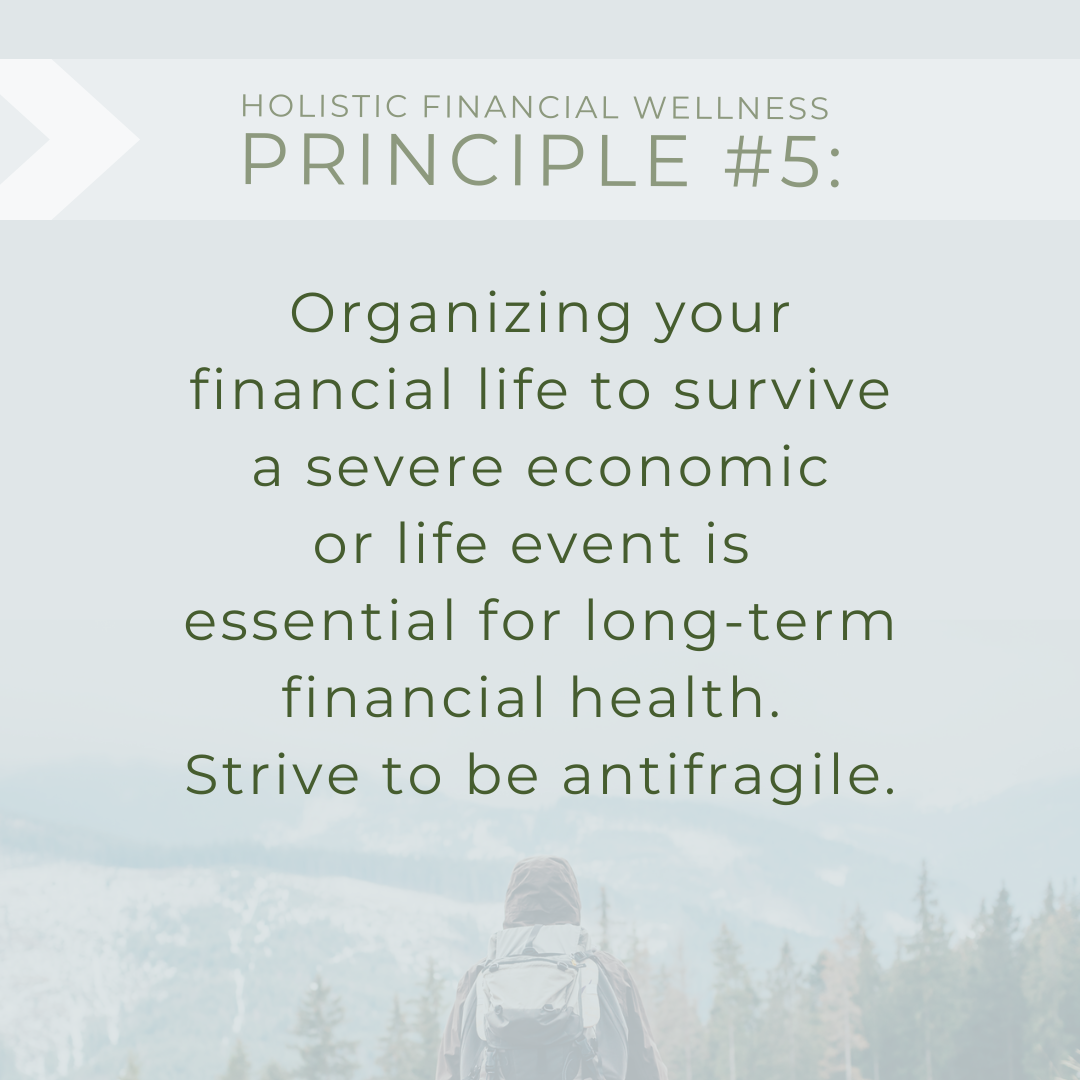
Holistic Financial Wellness Principles: Principle #5 – Hope for the Best, Prepare for the Worst

My minder, social media coach, cheerleader, and overall brave new world guru, Julia Page must take some responsibility for this essay about Holistic Financial Wellness Principle #5.

It’s not that she told me what to write. One of the reasons I hired her is because she is so good at letting me be me. I love to write but breaking my thoughts into bite size memes doesn’t come easily to me, and while Julia tolerates my long windedness, she told me that I needed to discard my original draft and write a crisper, more focused version of this essay so that it would be both easy to read and helpful to readers who struggle with money issues.

I understand that these days, people have very little time to devote to reading – maybe checking out a link during a break, listening to an idea passed on by a friend, or maybe, if you’re lucky, finding an insight from the avalanche of information in your daily feed that will help you solve a problem that is keeping you from making progress.

This seems to be the state of the world and a consequence of an acceleration and a compression of the time we are given to solve the problems we face. That is neither good nor bad, and I don’t spend much of my time trying to figure out who or what is to blame – it is just a feature of the world we live in.

And so, in this essay, while just as long as the others in this series is focused on the essential task of trying to help you understand the essence of HFW#5 and why it can help you survive and thrive financially.

Holistic Financial Wellness Principle #5 is perhaps the most difficult and counterintuitive of the principles I espouse. In addition to using the word “antifragile” – a word that doesn’t appear in any dictionary you are likely to have in your house, it relies to a great degree on the work of Nassim Taleb, a man who is not easy to understand – particularly the mathematics that forms the rock-solid basis for his conclusions. But just because Dr.Taleb is hard to understand doesn’t mean it is hard to understand what will help you survive and even thrive in a world of Black Swans and fat-tailed distributions. You won’t learn it all here, but at least you’ll get a taste of what Chapter 8 will tell you if/when you end up reading Money Mountaineering.

.

.

Fragility, Hidden Risks, and How the World Changes

“I know that history is going to be dominated by an improbable event, I just don’t know what that event will be.” ― Nassim Nicholas Taleb, The Black Swan: The Impact of the Highly Improbable

What Dr. Taleb says above has been shown to be the case again and again in the last several thousand years, but it took reading his three books (Fooled by Randomness, The Black Swan, and Antifragile) for me to really get it and start incorporating his insights into how I structured my financial life.

Fooled by Randomness taught me that most of the Probability and Statistics I learned in college and as an actuary, was, at best, incomplete, and, often, downright misleading. The Black Swan was sobering, but not as disorienting to me since as an actuary I was used to helping my clients protect themselves against things that almost never happen, but reading it helped me appreciate that the low probability/high impact events that do happen are the things that, in fact, change the course of history. This was hammered home by both the Financial Crisis of 2008 and the Pandemic of 2020 – which I think most of us would agree were exactly the kind of Black Swan events that Dr. Taleb talks about.

In 2012 Nassim Taleb published his third book Antifragile. By then I was enough of a fan to buy it as soon as it came out and devoured it immediately, learning that “fat tailed distributions” weren’t just the place where Black Swans come from, but are also the breeding ground for events that can make you stronger when the world changes in dramatic and unexpected ways.

Understanding Nassim Taleb and Using his Insights

Holistic Financial Wellness Principle # 5 says:

“Organizing your financial life to survive a severe economic or life event is essential for long-term financial health. Strive to be antifragile.”

What that means is first and foremost, that you should prepare to survive a potential Black Swan event, and second that you should try and structure your assets and liabilities in such a way that you benefit rather than suffer from the volatility that long term exposure to markets governed by fat tailed distributions will inevitably produce.

When the Financial Crisis of 2008 occurred, I was living and working in Paris, France and had the benefit of being able to watch the financial world crack and crumble from a safe distance. For the first time in my life, I realized that almost everyone who was responsible for “managing” our economy and keeping the global financial system operating didn’t know what was happening and, worse,  didn’t know how to stop the wildfire that was destroying corporations,  banks and even a giant insurance company (AIG) along with the financial lives of millions of people who were losing their homes, their jobs and even their pensions and retirement savings.

It is easy to forget how scary and uncertain those times were, and though our economy and the markets have recovered, the experience told me that not only can it happen again, but eventually it will happen again – not a “real estate bubble induced financial meltdown” but something else just as unexpected and just as world changing. When the Pandemic of 2020 came ashore and crashed our economy so severely that the country’s unemployment rate increased from under 4% to 14.7% in one month (something that had never happened before) I was ready, or, if not ready, at least prepared enough to not have to worry about by income or my ultimate financial survival.

Now that the economic crisis associated with COVID has passed, or at least morphed into something else, we are beginning to forget again how scared we all were about our money and our jobs and feel that things are getting back to normal – economically at least. Maybe so, but I still think the lessons of these two Black swan events should be incorporated into how we manage our financial lives and I believe that keeping Holistic Financial Wellness Principle #5 in mind can help.

So, what did I do to prepare, and why am I feeling ok financially?

It is because I took a “barbell” approach to my financial life to become antifragile and, through redundancy and insurance, made sure that if one part of my personal balance sheet disappeared, I would still have enough resources to sustain myself and rebuild anything that was lost.

I will tell you, in a minute, a little bit about what I did, but first I want to go slightly deeper into the insights that informed that strategy. From Dr. Taleb’s books I learned that

  1. Pronouncements by investment experts about the future behavior of many investment markets that are based on “historical patterns” including those based on capital market assumptions that come from  “sample means,  sample variances, and sample correlation coefficients” are almost certainly wrong because one of the statistical consequences of being in a fat tailed distribution is that you will never  be able to collect enough historical data to know just how likely or unlikely extreme returns (positive and negative) will be in a given market whether it be soy bean futures or cryptocurrency.
  2. The situation is not as hopeless as the above would suggest because it is possible to gain some insight into the nature and extent of the “fatness” of the tail of a given distribution, and, in particular, it is often possible to determine whether the likely nature of the distribution provides an opportunity for profiting from volatility

It is not at all obvious how to take advantage of item 2 from a theoretical perspective, but as a practical matter I believe that the concept of using a “barbell strategy” as I describe in Chapter 8 of Money Mountaineering is something to consider.

Beginning in early 2008 I started to model my financial strategy along these lines, first spreading my money among different banks eventually having significant percentages in 4 different major institutions. At the same time, I started to radically diversify my sources of retirement income, eventually obtaining Life Insurance and Annuities from 3 different major insurance companies as well as a Charitable Gift Annuity and a Charitable Remainder Trust from my old school which has an endowment of almost $500 million backstopping the life income that they will begin paying me when I turn 65. It goes without saying, that I also made sure that I had enough insurance to protect me against known contingencies like death, disability and other hazards that are more easily imagined (fire, theft, and being sued).

For the next few years, I didn’t worry too much about my long-term financial security. I had a secure and stable spot in the actuarial profession and was confident I would have enough income to meet my needs and then some until I had to stop working as a W-2 employee. That didn’t happen until 5 years ago, when in 2016, my company merged with another giant consulting/brokerage firm, and I decided to take early retirement.

As soon as I retired, I organized my financial life as two barbells. On the one hand I have a collection of diversified assets that will provide me with bullet-proof secure and steady income that will be enough for me to live on if I lose everything else. They include the annuities I described above, as well as cash value life insurance, the Pension benefits that I now receive from the companies I had worked for as an actuary and a an old 401(k) plan that is 100% invested in US TIPS (“Treasury Inflation Protected Securities”).

The above investments comprised a large percentage of my assets, so I don’t have a lot of extra cash to deploy to the other barbell, but what I did have, I deployed into highly speculative investments (mostly collectibles) whose payoff will likely follow “Pareto’s rule” –a form of fat tailed distribution where most of what you invest in earns nothing or less but every once in a while, you hit a “home run”. Since I didn’t have enough investable assets to construct a true second barbell (e.g., by becoming an “angel investor’ in multiple start-ups) I instead decided to invest my time in lots of different side ventures, most of which sill likely come to naught, but any one of which could substantially reward me if they are successful.  That is how I apply Holistic Financial Wellness Principle #5.

Get Ready for the Future

These days, Nassim Taleb continues to make his writing available to all who are curious to read about his ideas in real time. Specifically, if you go to academia.edu and follow him, you will be able to read many of his recent papers, both technical and not. Like many things in life, working through what Nassim Taleb has to offer the world is not easy, but for many of you it could represent a very smart investment of time and energy.

To provide one recent and particularly timely example, in June of this year, Dr. Taleb posted this paper about bitcoin:

https://www.academia.edu/49313911/Bitcoin_Currencies_and_Fragility

This one is not that difficult to read, but if you are not very “mathy” then the explanation of the paper posted by Michael Edesess on Advisor Perspectives in July explaining Dr. Taleb’s work should help. You can read it here:

https://www.advisorperspectives.com/articles/2021/07/18/why-nassim-taleb-says-bitcoin-is-worthless

In the last few years, many of my friends and colleagues have wondered why I speak about Nassim Taleb so frequently and with what is sometimes perceived as “missionary zeal”. I hope this essay has provided at least a partial answer.

The truth is that, if and when a true Apocalypse comes, none of what I or Dr. Taleb says will matter much, but until that day arrives, Dr. Taleb’s insights are well worth absorbing– particularly his understanding of the Fat Tailed Distributions in which we find ourselves embedded in. For me, the message is clear, and to paraphrase what I posted a while ago about risk management in a world governed by fat-tailed distributions:

“If you live your life believing that Life follows a Normal distribution, you will find that things almost never turn out as badly as you fear, except when they turn out much, much worse.”

But things can also turn out much, much better than you expect and that is where antifragility comes in.

Perhaps the best way I can explain my approach is to quote the advice my father used to give me throughout my childhood– “Hope for the best but prepare for the worst”. That and his advice to me shortly after I graduated college to “keep as many irons in the fire as you can” are two of the teachings that have allowed me to survive and thrive, in the world of money for over 40 years.

That, essentially is what Holistic Financial Wellness Principle #5 is all about.